
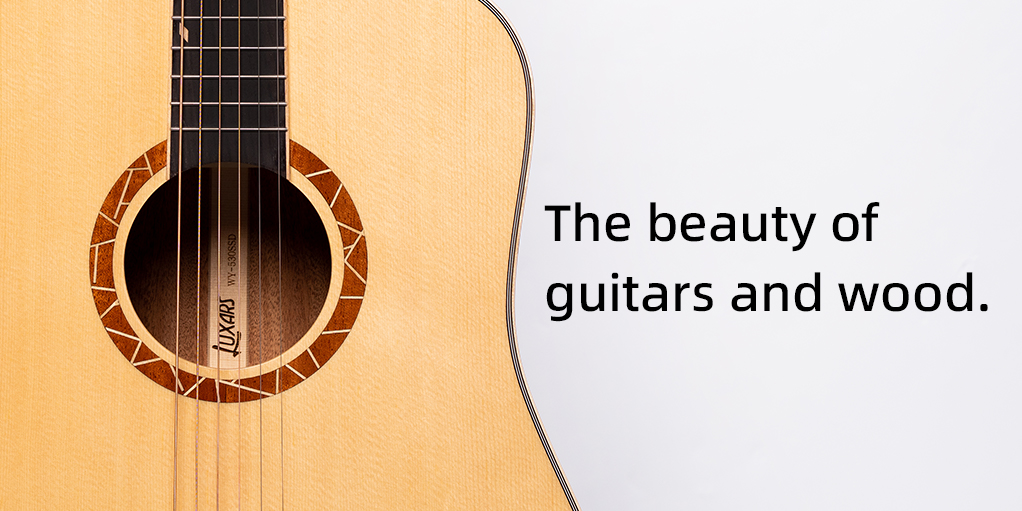
The Beauty of Guitar Woods
In the world of music, guitars attract countless enthusiasts with their unique charm. The tone and quality of a guitar largely depend on the wood used. Whether it’s an electric guitar or an acoustic guitar, different woods can endow them with unique personalities.
I. Woods for Acoustic Guitars
- Spruce
Spruce is one of the commonly used woods for the tops of acoustic guitars. It has a lightweight texture and good elasticity, capable of producing a bright, clear, and penetrating tone. The excellent resonance characteristics of spruce make the sound fuller and richer, with a lingering aftertone. Whether playing gentle folk songs or passionate fingerstyle pieces, acoustic guitars with spruce tops can show their unique charm. - Mahogany
Mahogany is often used for the back and sides of acoustic guitars. This wood has beautiful texture and a warm color, giving people a noble feeling. The tone of mahogany is warm and full, with excellent mid-low frequency performance and strong resonance. It can bring rich harmonics and a warm tone to acoustic guitars, very suitable for playing various styles of music. - Rosewood
Rosewood is also a common wood in acoustic guitars. It has fine texture and a deep color, with high decorative value. In terms of tone, rosewood has rich low frequencies and bright high frequencies, with a balanced and expressive tone. Acoustic guitars with rosewood back and sides usually have excellent resonance and a sense of layering in tone, suitable for playing classical music, jazz, and other styles. - Engelmann Spruce
Compared to Sitka spruce, Engelmann spruce grows more slowly and has finer annual rings. Its tone is warm and soft, with delicate and sweet high frequencies and rich mid-frequencies. The overall tone is very balanced and has good dynamic response, able to well express the emotion and details of music during playing. It is often used in the making of high-end acoustic guitar tops. - Cedar
Also known as red cedar. It has a lower density than spruce, and the sound is usually warmer than spruce. When played with a gentle touch, it sounds wonderful, especially in fingerstyle playing, it can amplify the quiet tones and show rich tone details. However, if played forcefully, the volume will reach its limit and the sound may become out of control. It comes in various shades from light to dark and is often paired with mahogany or rosewood as back and sides to make specific guitar bodies, suitable for guitarists with a delicate touch-playing style. - Koa
This is a tropical hardwood with a distinctive flame pattern and very beautiful appearance. In terms of tone, it combines the mid-frequencies of mahogany and the high frequencies of maple. New koa guitars may initially sound a bit too bright and tight, but after being fully played in, the mid-frequencies will become more open, the sound will become rich and sweet, and the resonance will be more sensitive. However, the low-frequency response of koa is relatively slightly weaker. It is suitable for fingerstyle guitarists who like to use various fingerpicks or picks for delicate plucking, and for guitarists who like bright sounds, they need to pay attention to its high-frequency brightness. - Maple
In addition to being used for the necks and fingerboards of electric guitars, maple is occasionally also used for the tops or back and sides of acoustic guitars. Acoustic guitars with maple tops have a bright tone, strong penetration and high-frequency response, bringing clear tone and good playing feel. When used as back and sides, it can increase the brightness and layering of the guitar, making the sound more rich and diverse.
II. Woods for Electric Guitars
- Alder
Alder is one of the commonly used woods for electric guitars. It has a lightweight texture, a bright tone, and good resonance characteristics. Electric guitars made of alder have excellent mid-high frequency performance, with a clear and penetrating sound. This wood is suitable for playing various styles of music, especially rock and pop. - Basswood
Electric guitars made of basswood have a warm and round tone, with relatively prominent mid-low frequencies. It has a lightweight texture and is easy to process, so it is widely used in the making of electric guitars. Basswood electric guitars are suitable for playing soft music styles such as folk and blues. - Maple
Maple is a hard wood and is often used for the necks and fingerboards of electric guitars. The tone of maple is bright, with strong penetration and high-frequency response. It can bring clear tone and good playing feel to electric guitars. In the body part of electric guitars, maple can also be used as a veneer to increase the beauty and tone layering of the guitar. - Ebony
It is a very hard wood that is not easily deformed. Its color is similar to rosewood, but the tone is bright. Most high-end handmade electric guitars will choose it as the fingerboard. Its surface is smooth and shiny, with a good texture, and can bring clear and bright high frequencies and a solid playing feel to electric guitars. - Ash
It is divided into white ash and swamp ash. White ash is lightweight, with straight grain and a bright tone. It has good resonance characteristics, with outstanding mid-high frequency performance. The sound is clear and has strong penetration, suitable for playing rock, pop and other styles. Swamp ash has a slightly higher relative density and a warmer and richer tone. - Walnut
It has a relatively hard texture and beautiful grain. When used for electric guitars, it can provide a warm and round tone, with relatively full mid-frequencies. At the same time, it also has a certain degree of clarity and layering, suitable for playing various music styles.
In conclusion, different woods bring rich and diverse tones and personalities to electric guitars and acoustic guitars. When choosing a guitar, understanding the characteristics of various woods can help you find the instrument that best suits your music style and needs. Whether you pursue a bright tone or warm resonance, there is always a wood that can fulfill your music dream.


